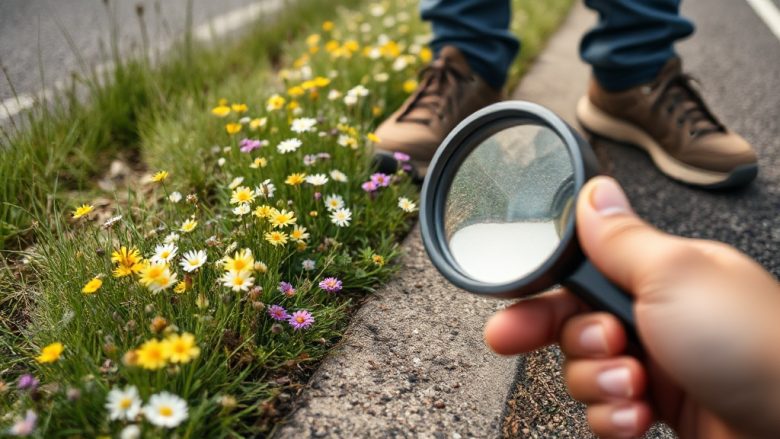
Wildflower spotting sounds like something that requires a free afternoon, a packed lunch and a proper pair of walking boots. It doesn’t. The truth is that most of the pleasure comes from the first twenty minutes, and you can find that window on a lunch break, between school pick-up and dinner, or on the walk from the car park to wherever you’re actually going. Wildflower spotting for busy people is less about covering ground and more about knowing where to pause.
The trick is to stop treating it as a day out and start treating it as a series of small, repeatable habits. You don’t need to identify everything. You don’t need to travel. You just need to know where the flowers hide, what to carry, and how to name a plant before your phone battery or your patience runs out.
Where to Look When You Only Have Minutes
The best wildflower patches for a tight schedule are almost never in the places that get written up as beauty spots. They’re in the scruffy margins of ordinary life. Once you start noticing them, you’ll find you were walking past them all along.
Start with edges. The strip of rough grass between a pavement and a fence, the verge along a quiet lane, the unmown corner of a park where the mower can’t quite reach. These liminal strips hold astonishing variety because they’re disturbed just enough to stop one aggressive species taking over, but not so much that nothing can set seed. A ten-metre stretch of verge in early summer can easily hold a dozen different species if you look properly.
Churchyards and old cemeteries are quietly excellent. They’re often managed lightly, they’re sheltered by stone walls, and they’ve had decades or centuries to build up a seed bank. You can do a full loop of a small churchyard in eight minutes and come away with a mental list of five or six flowers you didn’t expect.
Canals and riverbanks work well too, because the towpath gives you a ready-made linear route and the water keeps the ground damp enough for moisture-loving species. Railway embankments are brilliant in theory, but obviously keep to public paths and never trespass on the track itself. If you have a garden, the untidiest bit of it counts. Leave a patch unmown from spring and see what arrives on its own.
Timing matters more than location. Aim for mid-morning once the dew has lifted but before the heat of the day, when flowers are open and insects are active. Overcast, still days are underrated for spotting because colours read more evenly and nothing is wilting. If you only get one window a week, make it a dry one.
Seasonally, the calendar shifts depending on where you are, but a rough rhythm holds. Early spring brings the small stuff low to the ground. Late spring and early summer are the peak. High summer favours the tall, sun-loving plants along verges and field edges. Early autumn still has plenty if you know where to look, particularly on disturbed ground and stubble margins. You don’t need to memorise a calendar. Just notice what’s changed since your last walk.
What to Bring (and What to Leave Behind)
The single biggest mistake busy people make is over-packing. A rucksack full of gear turns a twenty-minute walk into a logistical operation, and you’ll skip it. Keep a small kit that lives by the door so there’s no decision to make.
A phone is genuinely enough for most identification now, and it’s already in your pocket. What matters is a hand lens, which sounds old-fashioned and costs very little. A simple 10x magnifier lets you see the details that separate one yellow daisy from another, and those details are usually the difference between a confident name and a shrug. If you wear glasses, a loupe that clips on is even easier.
Wear shoes you can stand in on wet grass. Not boots necessarily, just something that won’t have you hopping about. Long trousers are worth it in high summer if you’re pushing through anything tall, mostly for ticks and nettles. A light jacket with pockets beats a bag because it keeps your hands free.
Leave behind the field guide you never open. Leave the camera you’ll fiddle with instead of looking. If you want to record something, take one photo of the whole plant, one of the flower head and one of a leaf, then move on. That’s enough to identify it later from your sofa, which is often the most realistic way to do it when you’re short on time.
One thing worth carrying is a small notebook, or just the notes app on your phone. Jot the date, the rough location and a two-word description. Over a season, that little log becomes far more useful than any guide, because it tells you what’s out near you and when. It also stops you re-identifying the same plant every week.
Don’t pick anything. It’s tempting to take a stem home to identify, but many wildflowers are protected, some are scarce, and a picked flower can’t set seed for next year. Photograph it where it grows and leave it be. If you’re on private land or a nature reserve, follow whatever rules are posted, which usually just means staying on the path.
How to Identify Quickly Without Getting Bogged Down
Identification is where most people lose momentum. They try to name everything, get stuck on one awkward plant, and give up. The fix is to work in a fixed order and accept that you won’t get everything right.
First, count the petals if you can see them clearly. Four, five, six and many are the usual answers, and that one number narrows things enormously. Then look at the flower’s overall shape. Is it a flat disc, a bell, a spike, a cluster of tiny flowers that look like one? Shape beats colour every time, because colour varies and shape doesn’t.
Next, look at the leaves. Where are they on the stem, opposite each other or alternating? Are the edges smooth or toothed? Are they hairy, smooth, or covered in a silvery fuzz? Leaves are often more reliable than flowers because they’re there for longer and don’t change as much. If a plant has gone over, leaves are all you’ve got.
Then check the stem. Square or round? Hollow or solid? Hairy or not? This sounds fussy, but it’s a fast shortcut. Many of the mint family have square stems, and once you know that, you can rule out a lot of lookalikes in seconds.
Only after all that should you reach for an app or a book. Apps are quick and often right, but they’re most reliable when you’ve already narrowed the field. If an app gives you a confident answer for a plant you know is common in your area, fine. If it offers five options, take a photo and check later rather than standing in the rain scrolling.
Accept a personal rule: if you can name three new plants in a walk, that’s a good walk. You are not building a herbarium. You’re learning your local patch one plant at a time, and that knowledge sticks better than a rushed list.
It helps to learn a handful of very common species first, because they become landmarks. Once you can recognise a few familiar faces, everything unfamiliar stands out by contrast. Pick the plants you see most often and get those solid before chasing rarities.
One last efficiency tip: go back to the same place. Repeat visits to a single verge or park corner will teach you more than a dozen scattered trips, because you’ll see plants emerge, flower and set seed, and you’ll notice the changes that a one-off visit hides. Familiarity is the fastest identification tool there is.
None of this needs a special day. Twenty minutes, a pocket lens and a bit of attention will get you further than you’d think. The wildflowers are already on your route. You just have to slow down enough to see them.